This doctoral-level course examines the biblical, theological, philosophical, organizational, and strategic dimensions of educational leadership within Christian higher education. Students critically explore leadership theory, governance systems, organizational behavior, strategic planning, institutional transformation, financial stewardship, policy development, change management, human resource leadership, crisis management, and succession planning. Particular attention is given to servant leadership, institutional effectiveness, organizational culture, ethical decision-making, and the development of resilient Christian educational institutions capable of advancing the mission of Christ in an increasingly global and technologically complex environment. The course equips doctoral candidates to lead Christian universities, seminaries, Bible colleges, and theological institutions with academic excellence, biblical integrity, strategic vision, and faithful stewardship.
- Teacher: Site Owner
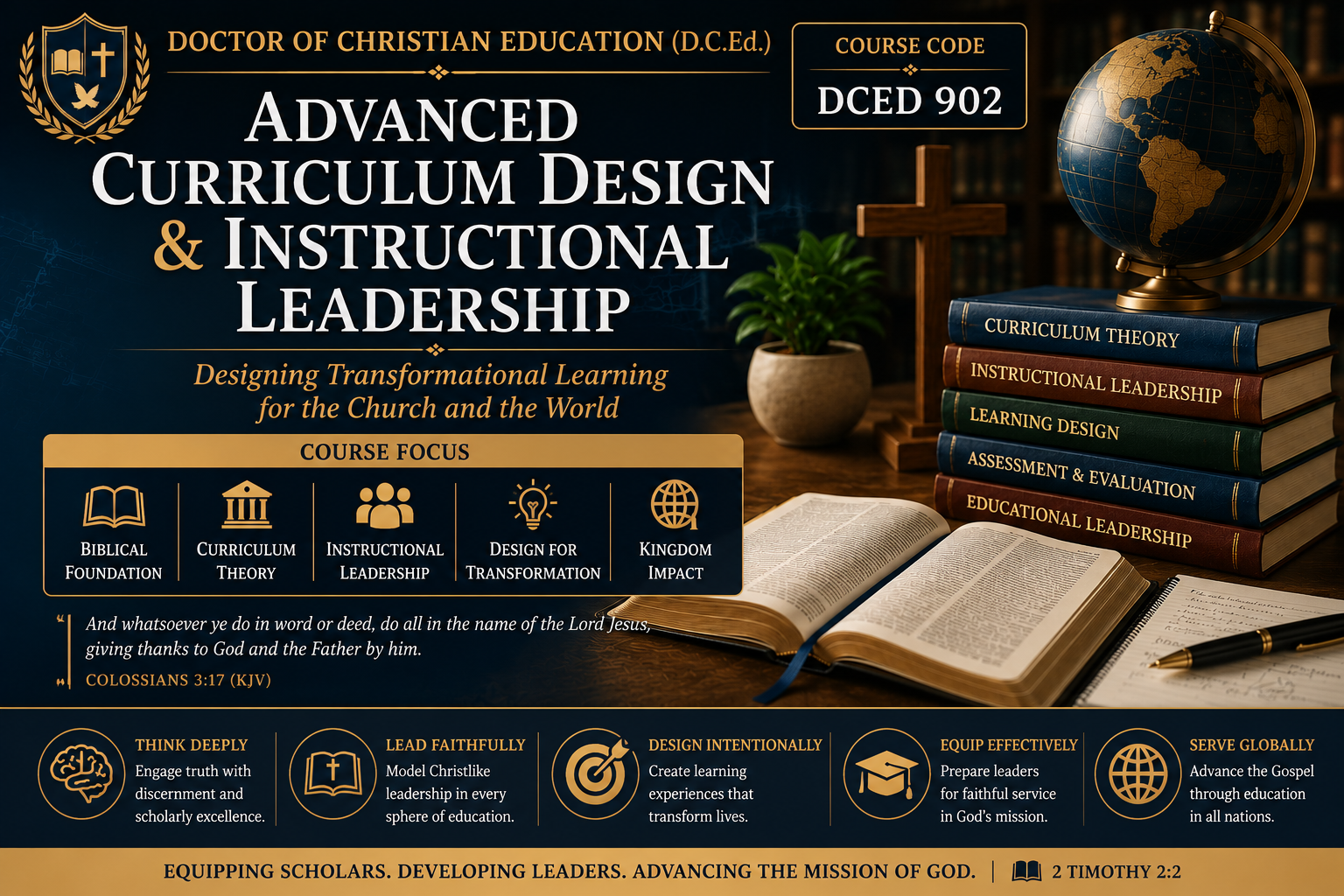
This doctoral course provides an advanced examination of curriculum theory, instructional leadership, educational innovation, and program development within Christian educational institutions. Building upon the biblical and philosophical foundations established in DCED 901, the course explores curriculum design as a strategic leadership function that shapes theological education, discipleship, ministerial formation, and institutional effectiveness.
Students critically evaluate contemporary curriculum models, competency-based education, outcomes-based education, instructional systems design, learning assessment, accreditation standards, educational quality assurance, digital learning environments, artificial intelligence, and curriculum innovation from a biblical worldview. Particular attention is given to designing doctoral-level curricula that integrate theological integrity, educational excellence, spiritual formation, leadership development, and global ministry relevance.
The course prepares Christian educational leaders to design, implement, evaluate, and continually improve curricula for churches, Bible colleges, seminaries, Christian universities, leadership institutes, and ministry training organizations. Emphasis is placed upon strategic instructional leadership that equips institutions to respond faithfully to changing educational contexts while preserving biblical truth and advancing the mission of Christ.
- Teacher: Site Owner
This doctoral-level course provides an advanced theological and biblical examination of the foundations of Christian education. Students explore the biblical narrative from Genesis to Revelation, tracing God's redemptive purpose as it relates to teaching, learning, discipleship, spiritual formation, and the transmission of faith across generations. Particular attention is given to the educational ministry of Israel, the teaching ministry of Jesus Christ, apostolic models of discipleship, and the educational mission of the contemporary Church. The course critically evaluates historical and contemporary educational philosophies in light of biblical revelation and develops a comprehensive theological framework for Christian education within diverse cultural contexts. Students will engage in advanced biblical interpretation, theological reflection, scholarly dialogue, and original research to formulate a biblically grounded philosophy of Christian education that informs educational leadership, curriculum development, and ministry practice.
- Teacher: Site Owner
 PS6003 Image.png
PS-9003 Orientation to Doctoral Studies is a foundational doctoral-level course designed to introduce students to the intellectual, methodological, ethical, and professional expectations of doctoral education. The course equips students with the skills, dispositions, and scholarly awareness required for successful progression through doctoral study.
Students are introduced to doctoral academic culture, advanced reading and writing practices, research paradigms and methodologies, ethical research conduct, supervisory relationships, and scholarly identity formation. Emphasis is placed on independent inquiry, critical engagement with literature, and responsible knowledge production.
The course also situates doctoral study within African and Global South contexts while maintaining engagement with global academic standards. Through reflective, analytical, and integrative assignments, students develop clarity regarding their research direction, scholarly identity, and doctoral progression strategy.
By the end of the course, students will be prepared to engage doctoral research with intellectual rigor, ethical integrity, and contextual awareness.
- Teacher: Site Owner